Why Your Charter Business Is Losing Bookings (And How the Right Software Fixes It)
Published by the FleetOS Team | March 2026 | Newsroom
There's a version of this story that plays out dozens of times a day across the charter industry.
A potential guest finds a vessel they like. They visit the website, look around, and want to book. But there's no availability calendar. No instant confirmation. No way to pay a deposit online. So they send an inquiry email — and then they wait.
By the time someone responds, they've already booked somewhere else.
That's not a sales problem. It's a systems problem. And it costs charter operators more revenue than most of them realize.
The FleetOS Booking Engine was built to close that gap entirely — automating the full reservation lifecycle so operators stop losing bookings to slow response times, double entries, and disconnected tools.
The Real Cost of Manual Booking Management
Most charter companies underestimate what manual booking processes are actually costing them. It's not just the occasional lost inquiry. It's the accumulated friction across every single reservation:
Time spent manually checking availability across vessels. Back-and-forth emails to confirm dates. Deposits collected through Venmo or bank transfer with no paper trail. Guest communications that fall through the cracks when someone's out on the water. Double bookings that happen because two team members were working from different calendars.
Every one of those friction points represents a conversion that didn't happen, a guest who didn't return, or an operator who spent hours on administration that should have taken minutes.
The charter booking software market has grown significantly as operators recognize this problem — but most of the available solutions were built for hotels, rental cars, or vacation properties. They require workarounds. They don't understand maritime-specific needs like vessel-specific pricing, multi-day charters, crew assignment tied to reservations, or deposit structures that vary by trip type.
FleetOS was built from the ground up for this exact use case.
How the FleetOS Booking Engine Works
The Booking Engine is one of the core modules in the FleetOS platform — and it handles the complete reservation lifecycle without requiring manual intervention at any stage.
Real-Time Availability
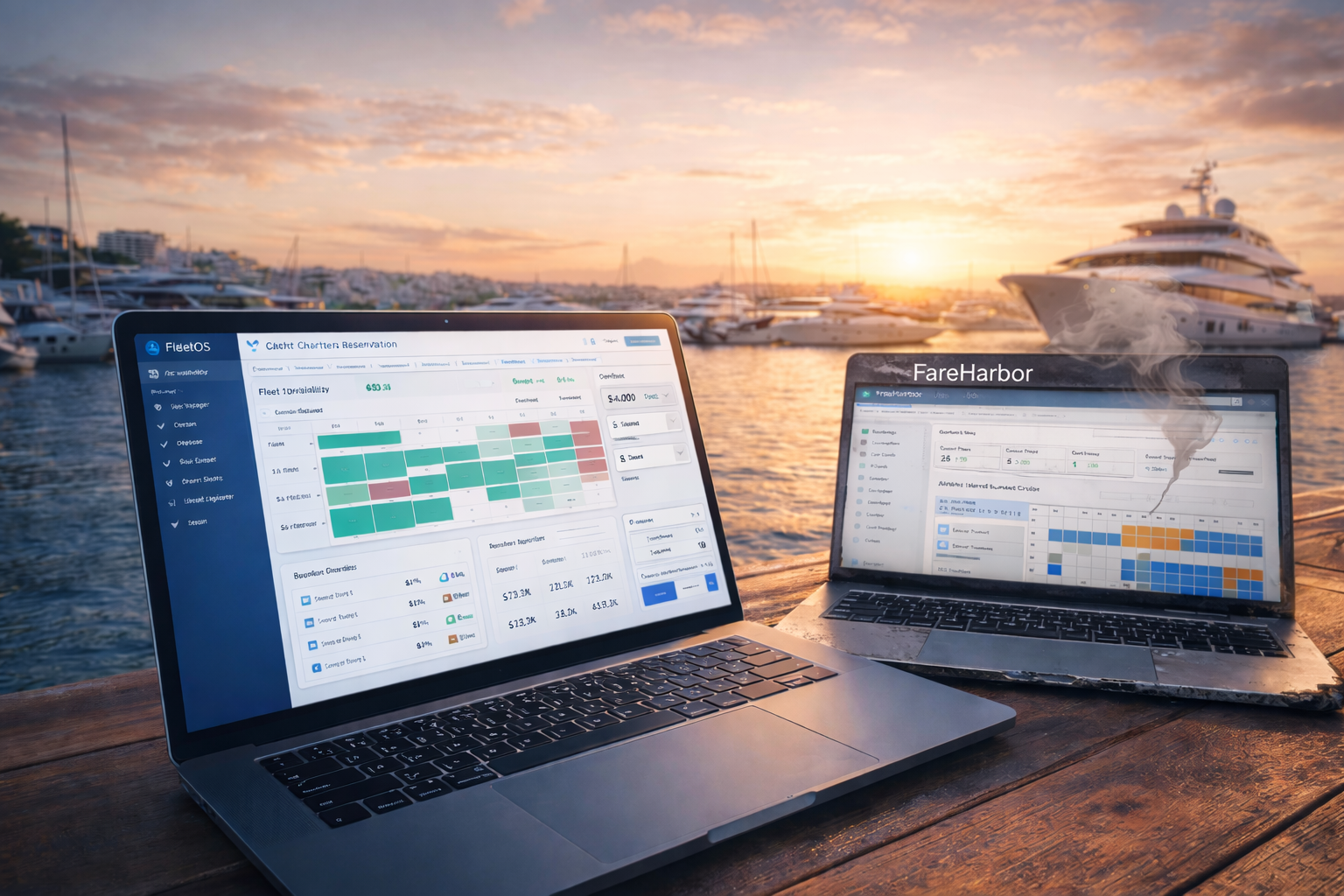
Every vessel in a fleet has its own live availability calendar inside FleetOS. When a booking is made, availability updates instantly. When a vessel goes into maintenance, it's automatically blocked from the booking calendar. Guests always see accurate availability — which means no double bookings and no awkward calls explaining that the date they chose is actually unavailable.
This alone eliminates one of the most common and damaging errors in manual charter management.
Instant Confirmations
The moment a booking is submitted, the guest receives an automated confirmation — professionally formatted, with trip details, vessel information, payment summary, and any preparation notes the operator wants to include. No waiting. No manual follow-up. No gap in the guest experience between the moment they decide to book and the moment they feel confident the reservation is secured.
Charter businesses that move to instant confirmation consistently see higher booking completion rates. When guests have to wait for human confirmation, abandonment goes up. When they get it immediately, they move forward.
Deposit Collection and Payment Processing
The Booking Engine handles deposit collection natively. Operators configure their deposit structure — percentage-based, flat rate, or full payment upfront — and guests pay at the time of booking through a secure payment gateway. No invoices to send manually. No bank transfers to track. No chasing guests for payment days before departure.
With $48K in revenue processed through a single operator's FleetOS dashboard in a single month, the payment infrastructure is built to handle real volume.
Automated Guest Communication
Every stage of the booking journey triggers the right communication automatically. Confirmation on booking. Reminder before departure. Follow-up after the trip. Operators can customize the messaging, the timing, and the content — but they don't have to manually send a single one.
For charter companies managing dozens of active bookings simultaneously, this is the difference between a professional guest experience and a chaotic one.
Calendar Synchronization and Conflict Prevention
FleetOS keeps availability synchronized across every booking channel so conflicts simply cannot happen. With 94% of bookings confirmed in the system and zero double-booking incidents built into the architecture, operators can take reservations from multiple sources without the risk of collision.
Beyond the Booking: How Reservations Connect to Everything Else
The real advantage of a purpose-built charter booking system over a standalone tool is integration. When a booking is made in FleetOS, it doesn't just update a calendar — it cascades across the entire operation.
Crew scheduling — The relevant crew members are flagged for availability checking and can be assigned directly from the booking record.
Vessel status — The booked vessel is automatically marked unavailable for the duration of the charter, preventing any subsequent conflicts.
Finance and invoicing — Revenue from the booking flows directly into the financial dashboard, contributing to real-time revenue tracking and YTD reporting without any manual data entry.
CRM and client history — The guest's booking is added to their client profile, building a history that helps operators personalize future interactions, track retention, and identify their highest-value customers.
This is the gap that standalone booking tools can't fill. A hotel booking plugin doesn't know about your crew certifications. A generic reservation system can't generate an invoice. FleetOS connects every layer because it was built as a complete operating system for charter businesses — not a single-purpose widget.
White-Label Booking Sites Included
One of the most underappreciated features in the FleetOS Booking Engine is the white-label site capability. Operators don't just get a booking tool — they get a fully branded customer-facing website where guests can browse vessels, check availability, and complete their reservation.
The site carries the operator's brand, not FleetOS's. Guests experience a professional, cohesive booking process that builds trust in the charter company — while the backend infrastructure is entirely powered by FleetOS.
For smaller operators who don't have the budget for custom web development, this is a professionally designed, conversion-optimized booking presence that would otherwise cost thousands of dollars to build independently.
The Marketplace: A Built-In Demand Channel
Operators who list on the FleetOS Marketplace gain exposure to thousands of charter customers already using the platform to search for vessels. This is a demand channel that most standalone booking tools simply don't offer — and it means new operators can start receiving booking inquiries without building their own audience from scratch.
The Marketplace sits alongside the operator's own white-label site, creating two concurrent booking channels managed from the same dashboard.
What 156 Bookings in a Month Actually Looks Like
The numbers visible in the FleetOS dashboard aren't hypothetical. A charter company running 24 active vessels, processing 156 bookings a month at a 94% confirmation rate, generating $48K in monthly revenue — that's the operational scale the Booking Engine is designed to support.
At that volume, manual booking management isn't just inefficient. It's impossible. Automation isn't a nice-to-have. It's what makes the business function.
FleetOS was built to handle that scale from day one — and to grow with operators as their fleet and booking volume expands.
Getting the Booking Engine Live
The FleetOS setup process is designed for operators who need to move fast. From account creation to a live booking engine takes under an hour:
Create your account — two minutes, no credit card required during the trial
Configure your booking settings — pricing models, deposit structure, vessel listings, and automated messaging
Connect your payment gateway — Stripe integration included
Go live — on the FleetOS Marketplace and your white-label site simultaneously
The 14-day free trial includes full access to the Booking Engine and every other module in the platform. There are no per-seat fees, no booking volume limits, and no long-term contracts required to start.
The Bottom Line
Charter businesses lose bookings every day because their systems create friction that guests won't wait through. The FleetOS Booking Engine removes that friction entirely — automating availability, confirmations, deposits, guest communication, and calendar management from a single dashboard that connects to every other part of the operation.
If your current booking process involves any manual steps between a guest's decision to book and a confirmed reservation in your system, there's revenue leaving the table.
The fix is a free trial away.
Start your 14-day free trial at fleetos.io — no credit card required.
Already running a charter operation and want to see the Booking Engine configured for your specific setup? Reach out to the FleetOS team directly through the site to schedule a personalized walkthrough.
FleetOS is a maritime fleet management SaaS platform serving charter companies, marinas, and fleet operators globally.
Tags: charter booking software, yacht booking system, boat rental booking engine, online charter reservations, maritime booking platform, fleet booking management, charter management software, yacht charter software, marina booking system, FleetOS booking engine, automated charter bookings, white-label charter website