The Hidden Compliance Risk in Every Charter Business (And the Software That Eliminates It)
How FleetOS Crew Scheduling Works
Published by the FleetOS Team | March 2026 | Newsroom
There's a version of a maritime compliance failure that operators think about — the dramatic one. An inspection that grounds a vessel. A certification that expired six months ago, discovered the day before a high-value charter. A crew member assigned to a trip without the qualifications the booking required.
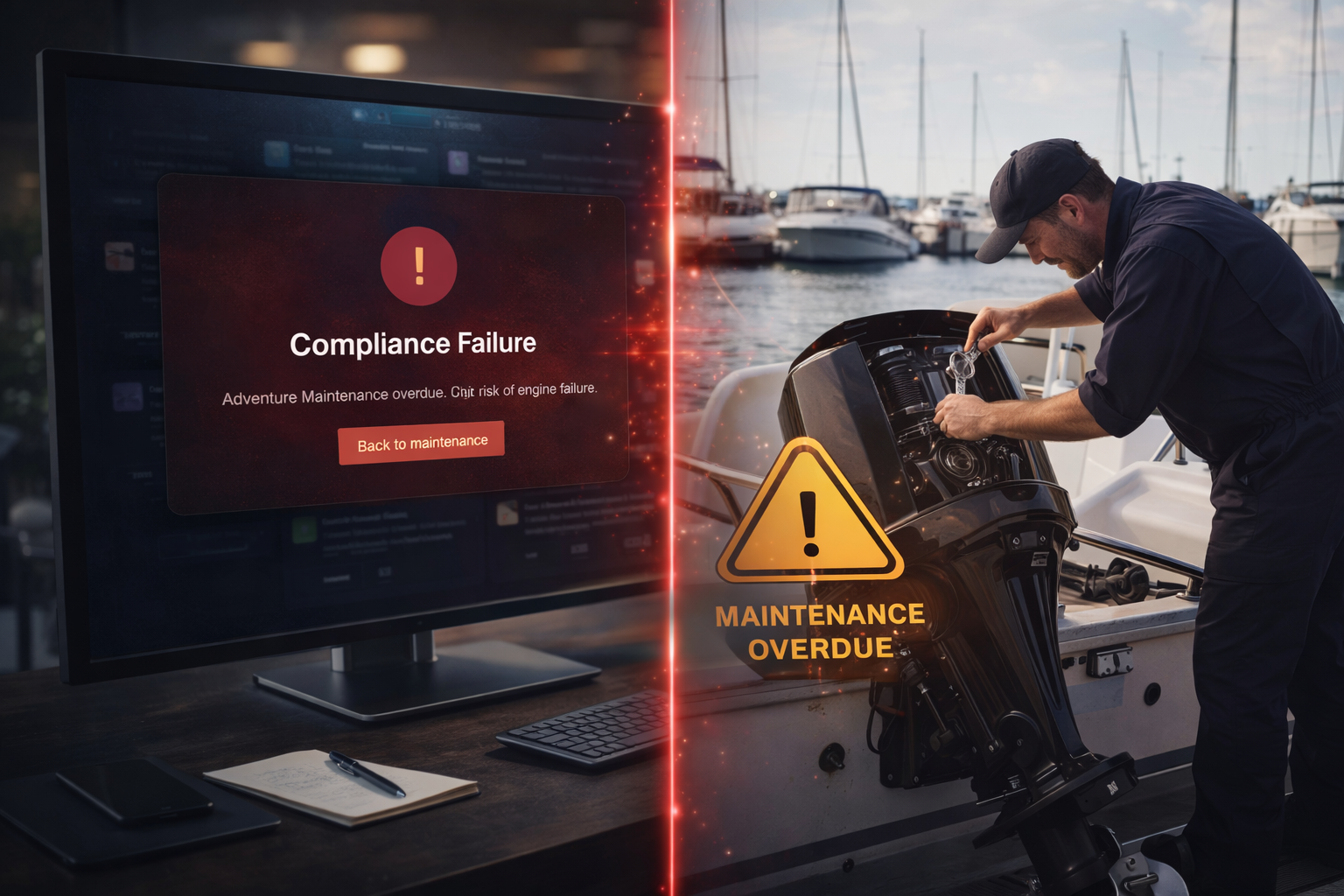
But most compliance problems in the charter industry don't announce themselves dramatically. They accumulate quietly. A maintenance reminder that got buried in an inbox. A crew certification renewal that slipped because someone assumed someone else was tracking it. A service interval missed not because anyone was negligent, but because the operation was running on too many disconnected systems to catch everything.
The FleetOS Crew Scheduling and Maintenance modules were built to close both of those gaps — keeping 45 crew members organized, zero scheduling conflicts, and 100% maintenance compliance not as aspirational targets but as operational defaults.
Why Crew Management Breaks Down at Scale
A solo operator running one vessel with a single captain and a regular deckhand can manage crew scheduling informally. But that model breaks down quickly as operations grow — and in the charter industry, growth happens faster than systems get updated.
Add a second vessel and you need to track two sets of crew availability simultaneously. Add a third and you're juggling certification expiry dates across a dozen people, availability windows that change week to week, and trip-specific qualification requirements that vary by vessel class and destination. Do all of that manually and the margin for error grows with every hire.
The consequences of crew scheduling errors in maritime operations are different from most industries. A double-booked meeting is an inconvenience. An uncertified crew member on a vessel is a liability — for the guest, for the operator, and for the license that makes the business legal.
Most charter operators don't have a dedicated HR system. They manage crew in spreadsheets, group chats, and shared calendars that weren't built for the specific demands of maritime scheduling. FleetOS Crew Scheduling replaces all of that with a purpose-built system that handles the complexity automatically.
How FleetOS Crew Scheduling Works
The Crew Scheduling module gives operators a single, real-time view of every crew member in their operation — availability, certifications, current assignments, and upcoming trips — from one dashboard.
Availability Management
Every crew member maintains an availability profile inside FleetOS. When a new trip is being planned, the system surfaces only crew members who are available for that date range, on that vessel, with the qualifications the trip requires. There's no manual cross-referencing of separate calendars, no group chat polling, no risk of assigning someone who's already committed elsewhere.
With 45 crew members manageable from a single view and zero scheduling conflicts built into the system architecture, operators running large fleets get the same organizational clarity as solo operators — regardless of headcount.
Certification Tracking
Maritime crew certifications aren't optional and they don't renew themselves. STCW, captain's licenses, first aid certifications, vessel-specific endorsements — every qualification has an expiry date, and every expiry date is a potential liability if it slips past unnoticed.
FleetOS tracks certification status for every crew member and surfaces upcoming renewals before they become problems. Operators see which crew members are fully certified, which have renewals approaching, and which are currently flagged — without running manual audits or trusting anyone to self-report.
The 12 certified crew members visible in the FleetOS dashboard represent exactly this kind of active compliance tracking: real-time certification status, always current, always visible.
Trip Assignment
Assigning crew to a trip in FleetOS takes the availability and certification data and puts it directly into the booking workflow. An operator planning a multi-day sail can see immediately which captains hold the right offshore certifications, which deckhands are available for those dates, and which combinations create scheduling conflicts — all before confirming anything with the guest.
The result is a crew assignment process that takes minutes rather than the back-and-forth coordination that can stretch over hours when managed manually.
The Maintenance Problem That Grounds Vessels
Crew compliance gets attention because it's visible — an uncertified crew member is a person, and people are easy to track in ways that maintenance schedules are not.
But vessel maintenance compliance is, if anything, more operationally critical. A vessel out of compliance with its service schedule isn't just a regulatory risk. It's a mechanical risk. And a mechanical failure mid-charter — engine trouble offshore, systems failure in open water — is the kind of incident that ends not just a booking but a business.
The challenge is that maritime maintenance schedules are complex. Different systems on the same vessel have different service intervals. Safety equipment has its own certification and inspection schedule. Engine hours, not just calendar dates, determine some service triggers. Tracking all of it manually across a multi-vessel fleet is genuinely difficult, and the consequences of getting it wrong are severe.
FleetOS Maintenance is built around automated tracking and proactive alerting — ensuring that nothing slips through, regardless of how many vessels are in the fleet or how busy the season gets.
How FleetOS Maintenance Works
Automated Reminders
Service schedules are configured once inside FleetOS and the system takes it from there. Reminders surface ahead of due dates — not the day something becomes overdue, but far enough in advance that the operator can schedule the work, procure parts if needed, and keep the vessel in rotation with minimal disruption.
With the next scheduled service surfacing on March 15 and $2.4K in monthly maintenance costs tracked in real time, the financial visibility is as important as the scheduling visibility. Operators who know what maintenance is costing them by vessel, by month, and by system can make better decisions about fleet composition, replacement timing, and pricing.
Maintenance History Logs
Every completed service is logged in FleetOS — what was done, when, by whom, and at what cost. This history serves multiple purposes simultaneously. It's the documentation an operator needs if a vessel is inspected. It's the data an operator needs to spot recurring issues before they become expensive failures. And it's the record that protects an operator legally if a maintenance dispute ever arises.
Vessels without documented maintenance histories are harder to sell, harder to insure, and harder to defend in a liability situation. FleetOS builds that history automatically, as a byproduct of normal operations.
Compliance Status
The 100% compliance figure visible in the FleetOS maintenance dashboard isn't a marketing target — it's what the system is designed to deliver as a default state. When every service interval is tracked, every reminder fires on time, and every completed job is logged, full compliance isn't an achievement. It's just what happens when the system is doing its job.
How Crew and Maintenance Work Together
The real operational value of having crew scheduling and maintenance in the same platform as bookings and fleet management is the way information flows between modules without manual intervention.
When a vessel goes into scheduled maintenance, it's automatically blocked from the booking calendar — no double booking risk, no awkward call to a guest explaining that their vessel is unavailable. When a crew member's certification is approaching expiry, the system flags it before any trips are scheduled that would require that certification. When a booking is confirmed, crew availability is checked against the entire existing schedule, not just the current week.
These aren't features that work in isolation. They're a connected operating layer that makes the whole fleet run more predictably — and more safely.
Who Needs This Most
The FleetOS Crew Scheduling and Maintenance modules are most immediately valuable for three types of operators:
Growing charter companies — operators who started with one or two vessels and informal systems, and who are now running five, ten, or more. The complexity doesn't scale gracefully with informal tools, and the compliance risk grows with every vessel added.
Operators in regulated markets — charter companies operating in jurisdictions with active maritime inspection regimes, where documentation and certification compliance is regularly checked and penalties for non-compliance are significant.
Operators with high crew turnover — the charter industry has seasonal dynamics that mean crews change, certifications vary, and availability windows shift constantly. A system that tracks all of it automatically is not a luxury in this environment — it's a necessity.
Getting Started
Both the Crew Scheduling and Maintenance modules are included in every FleetOS plan, activated as part of the standard platform configuration. There's no separate module purchase and no additional setup beyond configuring crew profiles and vessel service schedules — both of which can be done in a single session.
The 14-day free trial at fleetos.io gives operators full access to every module with no credit card required. Most operators have their crew profiles and maintenance schedules configured within the first hour.
Start your free trial at fleetos.io — no credit card required. Full platform access from day one.
FleetOS is a maritime fleet management SaaS platform serving charter companies, marinas, and fleet operators globally.
Tags: maritime crew management software, yacht crew scheduling, charter crew certification tracking, vessel maintenance software, boat maintenance tracking, maritime compliance software, charter business compliance, STCW certification tracking, fleet maintenance management, vessel service schedule software, charter operations software, maritime fleet compliance, FleetOS crew scheduling, FleetOS maintenance